Science · News · 28 Oct 2026
A cat's head in Carina, and other star nurseries Webb showed us this month
Late October brought a run of new images of stellar birthplaces from Webb and Hubble, culminating in a dusty pillar in the Carina Nebula with a distinctly feline profile.
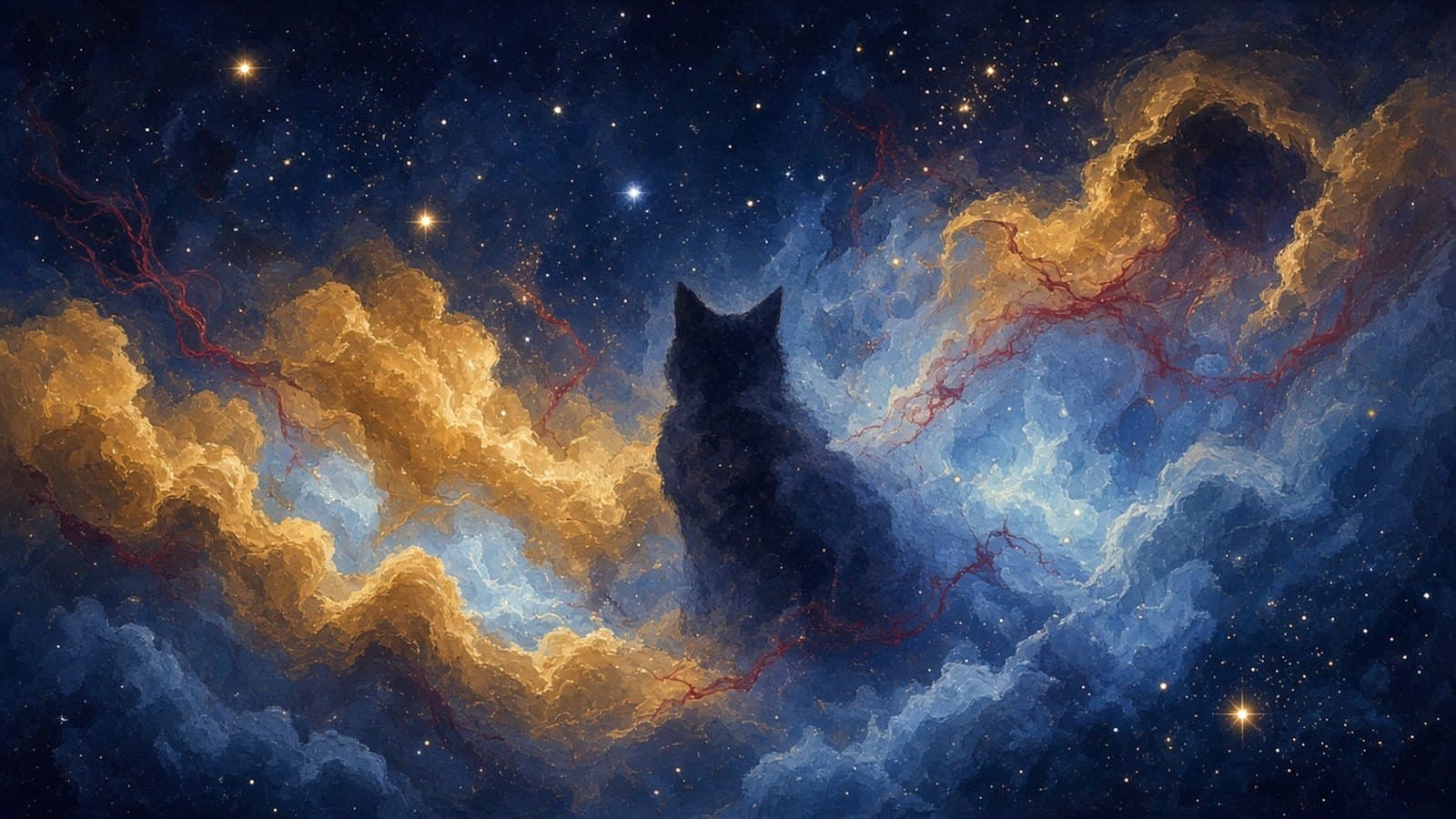
Illustration: FeelArtsy Studio (AI-assisted)
Astronomers are supposed to be immune to pareidolia, the habit of seeing faces in clouds. The space agencies, happily, are not. On 28 October, the European Space Agency published a set of images of the Cat's Head Nebula, a dense, dusty pillar in the Carina Nebula about 7,500 light-years from Earth. Squint a little and you can make out the ears.
Three telescopes' worth of cat
The Cat's Head was released as a comparison. One version uses Hubble's WFC3 camera in visible light. The others use Webb's two main instruments: NIRCam in the near-infrared and MIRI in the mid-infrared. Put side by side, they show what each kind of light reveals. Visible light shows the silhouette of the dust. Near-infrared light sees through it to the young stars embedded inside. Mid-infrared light picks out the warm dust itself, glowing like embers.
Carina is one of the most productive star-forming regions in our galaxy. Pillars like this are made by radiation and winds from massive stars nearby, which erode the surrounding gas until only the densest knots survive. Those knots are where new stars form.
A month of nurseries
The cat came at the end of a busy month for stellar portraits.
N159, released on 22 October, is a turbulent star-forming region in the Large Magellanic Cloud, a satellite galaxy about 161,000 light-years away. Webb's image spans about 230 light-years. What makes it interesting is chemistry. The Large Magellanic Cloud contains a smaller share of heavy elements than our own galaxy, closer to conditions in the early universe. Studying star birth there is a little like visiting the cosmic past. NASA highlighted the same view on 28 October.
NGC 7129, published by ESA/Webb on 6 October, is closer to home at about 3,300 light-years. At its heart is a young star of five to eight times the mass of the Sun, still settling into adulthood. It has carved a golden cavity around 3.5 light-years across. A disc around the star casts a long shadow into the surrounding cloud, much like the "Bat Shadow" Hubble photographed in another nebula.
Why these pictures matter
It's easy to treat space images as wallpaper, and they do make glorious wallpaper. But each is also a dataset. The colours are carefully mapped from wavelengths our eyes can't see. That's why the same object can look so different in visible and infrared light, and why scientists want both.
If you like your walls to carry a bit of cosmos, look for work that borrows this palette of deep navy, ember orange, gold and violet. It is the same colour scheme the universe uses for its nurseries.
Palette
- #0B1D3A
- #E07A3F
- #F2C14E
- #6C4AB6
- #3FA7D6
Sources
- Cat's Head Nebula (Hubble WFC3, Webb NIRCam, and Webb MIRI images) · European Space Agency
- Stars brewing in a nebulous cauldron · European Space Agency
- Webb Sees Turbulent Star Nursery · NASA
- Webb captures commotion from nebula's stellar jets · ESA/Webb
Written by FeelArtsy in our own words. AI may assist the draft. A person reviews it before it is published. See the editorial policy.
From the shop
Prints related to this story. House lines, designed by FeelArtsy Studio.
Moon and Stars Wrapping Paper
Still Form
€9.90
A FeelArtsy Studio line
Sleepy Moon New Baby Card
Lumen Wash
€5.50
A FeelArtsy Studio line
Halftone Sphere Poster
Meridian Block
€24.00
A FeelArtsy Studio line
Get the weekly trend letter
One letter a week on art, design, science, and what we printed from it. We store your address as pending and send a confirmation before the first letter. That confirmation email is not going out yet.