Science · News · 22 Oct 2026
Fiery red and stretchy orange: two new siphonophores from the deep
MBARI researchers and partners describe two new species of the deep-sea siphonophore Bargmannia, uncovered with decades of underwater video and a bit of museum detective work.
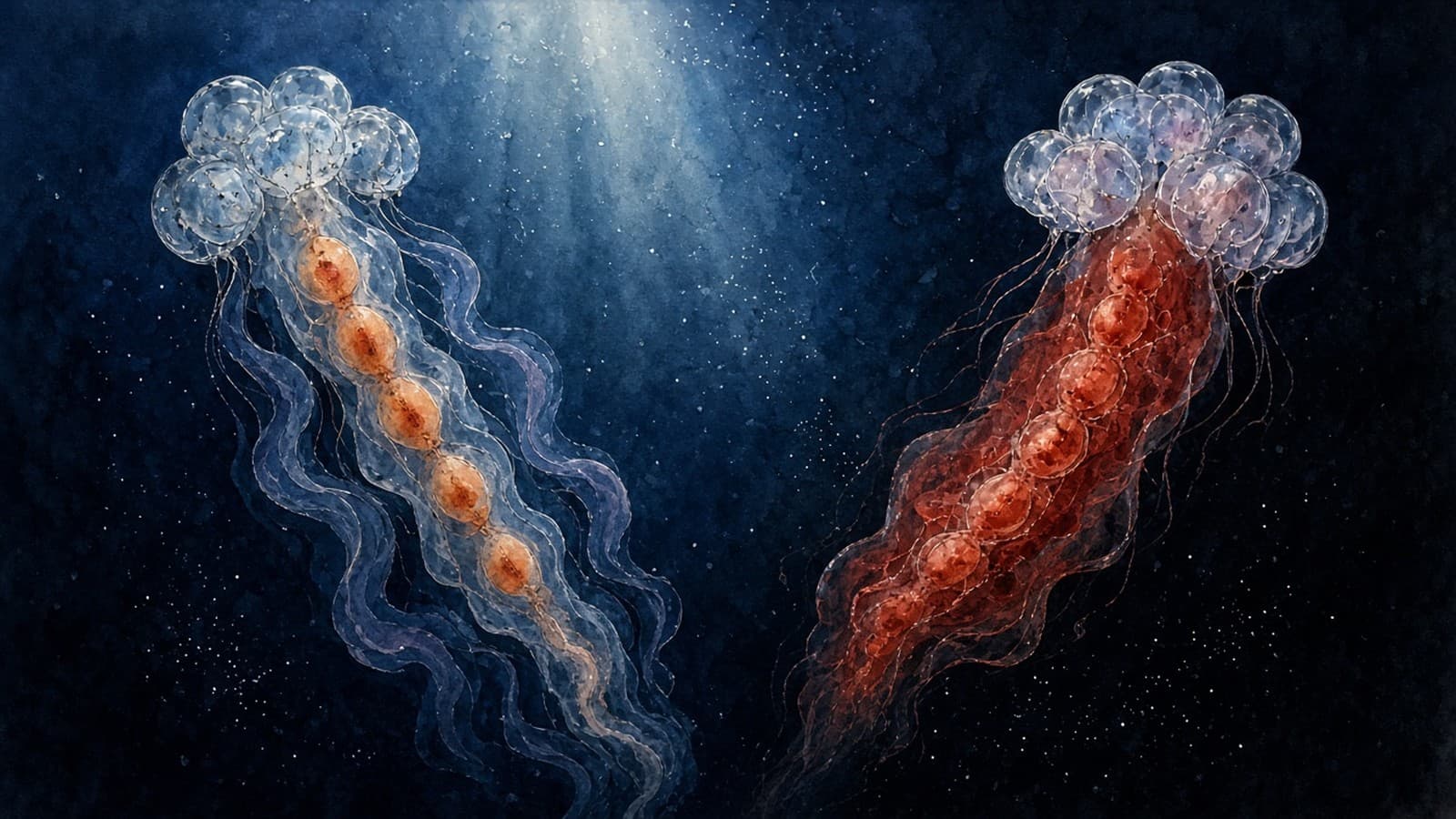
Illustration: FeelArtsy Studio (AI-assisted)
The deep sea keeps reminding us how little we know about our own planet. On 22 October the Monterey Bay Aquarium Research Institute (MBARI) announced that its scientists and colleagues had described two new species of siphonophore. They are delicate, jet-propelled animals from the ocean's dark middle layers.
What's a siphonophore?
Siphonophores are long, gelatinous animals, related to jellies and corals. In the ocean's midwater, the open water between the surface and the seafloor, they are among the dominant predators. Yet they're hard to study because they're so delicate. MBARI's team watches them in their natural habitat with underwater robots and collects them gently for the lab. Bargmannia are among the most streamlined of the group. They're pushed along by dozens of swimming bells that pulse together.
Meet the newcomers
Both new species belong to the genus *Bargmannia*:
- *Bargmannia marlena is notable for its stretchy orange stomachs*.
- *Bargmannia pyrosa has a fiery red body*, hence its name.
The team brought together researchers from MBARI, the University of Gdańsk, New York University and Yale. They looked across the genus as a whole. They combined museum specimens, observations from underwater robots and genomic sequencing. MBARI's video archive held seven species, and an eighth turned up in museum collections. The eight fall into two evolutionary lineages. Their ranges overlap geographically, but they're sorted by depth, which shows how species can evolve in a three-dimensional world. Both new species were recorded in the Gulf of California, at depths of roughly 1,100 and 1,700 metres.
Clever science
One detail shows how far the tools have come. The team managed to sequence DNA even from a specimen that had been preserved in formalin, a chemical known for damaging genetic material. That opens up old museum collections as a source of genetic data.
The research is published in the Zoological Journal of the Linnean Society (Mańko et al., 2026). MBARI says its researchers have now contributed to the discovery of more than 300 new species.
Why it matters
You can't protect what you haven't named. The study also cleared up old taxonomic confusion that had underestimated how many kinds of Bargmannia exist. The lesson goes beyond one genus: the deep ocean likely holds far more diversity than our catalogues show. Patient work with robots, archives and old museum jars is how we find it.
It's also just wonderful. Somewhere in the Gulf of California, a fiery red animal is jetting through the dark, and now it has a name.
Ocean colours at home
The deep sea's palette is unexpectedly gorgeous: inky blues with sudden flashes of orange and red. Ocean prints with deep indigo and shell or wave motifs bring that mood indoors without a single tentacle.
Palette
- #0A1931
- #E4572E
- #F7A072
- #3E92CC
- #F2F5EA
Sources
Written by FeelArtsy in our own words. AI may assist the draft. A person reviews it before it is published. See the editorial policy.
From the shop
Prints related to this story. House lines, designed by FeelArtsy Studio.
Indigo Tide Canvas
Field Pigment
€59.00
A FeelArtsy Studio line
North Sea Swell Canvas
Field Pigment
€59.00
A FeelArtsy Studio line
Seashell Rows Art Print
Still Form
€24.00
A FeelArtsy Studio line
Get the weekly trend letter
One letter a week on art, design, science, and what we printed from it. We store your address as pending and send a confirmation before the first letter. That confirmation email is not going out yet.