Science · News · 6 Oct 2026
A Nobel for listening to the universe through a cubic kilometre of ice
Francis Halzen receives the 2026 Nobel Prize in Physics for IceCube, the Antarctic detector that caught high-energy neutrinos arriving from deep space.
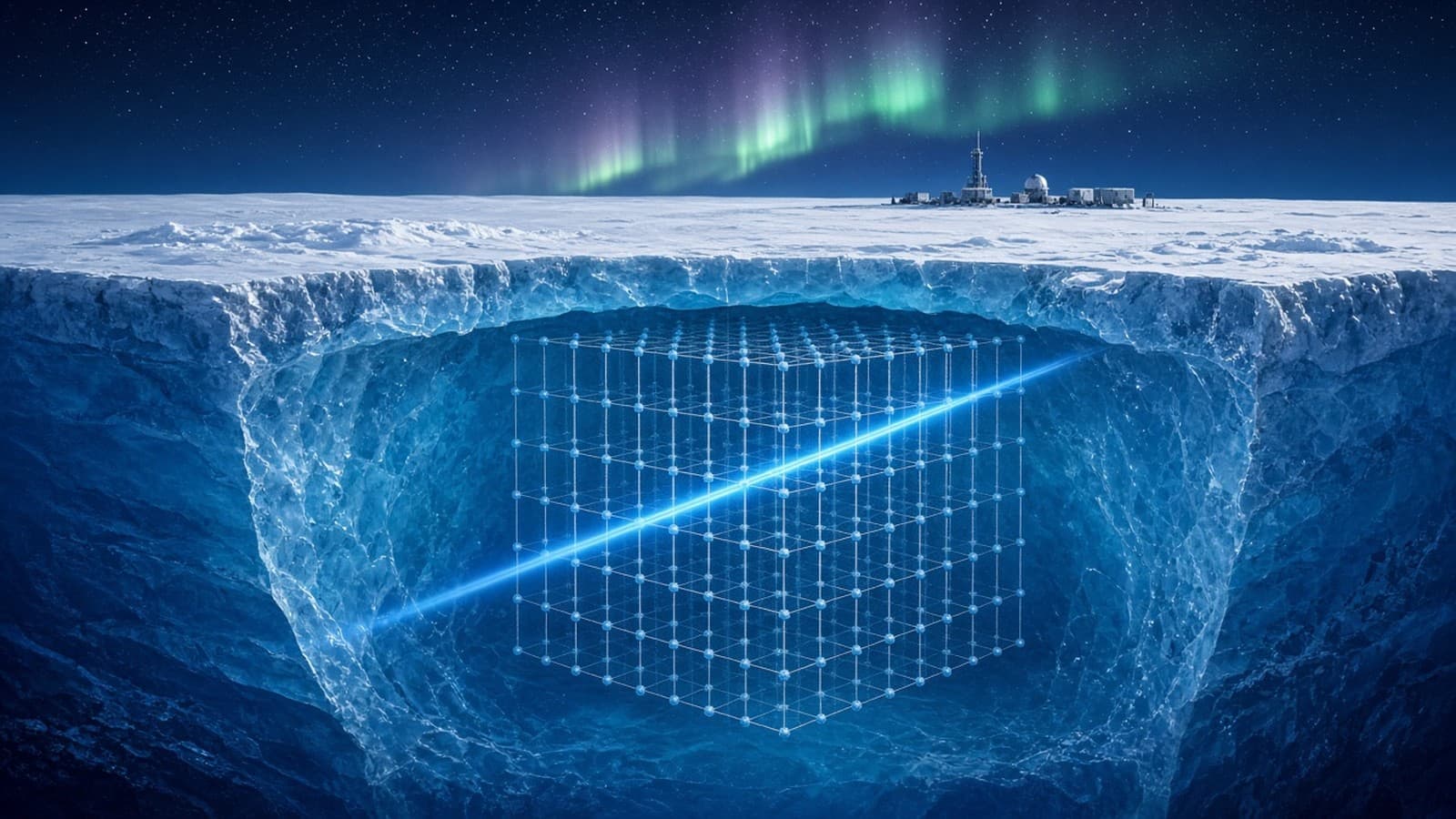
Illustration: FeelArtsy Studio (AI-assisted)
Some telescopes collect light. The one honoured by this year's Nobel Prize in Physics collects something much more elusive, and it does it with ice. On 6 October the Royal Swedish Academy of Sciences awarded the 2026 Nobel Prize in Physics to Francis Halzen of the University of Wisconsin–Madison. The citation honours his "decisive contributions to the IceCube Neutrino Observatory and the discovery of high-energy neutrinos of astrophysical origin".
The ghost particles
Neutrinos are among the most common particles in the universe and among the hardest to catch. They pass straight through the Earth, and through our bodies, without anyone noticing. That's also what makes them valuable. Unlike other particles, neutrinos reach us without changing direction or losing energy. If you can catch one, it carries information you can't get any other way, including where it came from.
The difficulty is the catching. Interactions are so rare that you need an enormous, transparent volume of matter and very sensitive eyes watching it.
Building an observatory in ice
Halzen's answer, first proposed in 1988, was to use the ice sheet at the South Pole. The completed IceCube detector, finished in 2011, instruments about a cubic kilometre of ice. It's fitted with light sensors deep in the clear glacial ice. When a neutrino very occasionally collides with an atomic nucleus, it produces a flash of light that the sensors can track. The site helps too: the polar ice is free of many kinds of interference, and the area is geologically stable.
It took decades of persistence, engineering at one of the harshest places on Earth and a large international collaboration to get there. The reward was the first detection of high-energy neutrinos from beyond our solar system. It was a new way of seeing the universe, sometimes called neutrino astronomy.
The laureate
Halzen was born in 1944 in Tienen, Belgium. The prize is worth 12 million Swedish kronor. The Nobel Committee also credited the international team of researchers and engineers he led. Its chair said Halzen's tenacity and vision paved the way for a new kind of astronomy.
Why it captures the imagination
There's something deeply poetic about IceCube: an observatory you can't see, buried in ice, watching for faint flashes of light caused by particles from the far side of the cosmos. It's a reminder that discovery often comes from patience and from finding an unexpected material that can do something extraordinary.
If that blend of cold blues and northern lights speaks to you, glacial lakes, starry skies and deep indigo seas bring the same calm, cosmic mood into a room.
Palette
- #0D1B2A
- #5FA8D3
- #A8E6CF
- #F4F9FC
- #1B4965
Sources
- Press release: Nobel Prize in Physics 2026 · NobelPrize.org
Written by FeelArtsy in our own words. AI may assist the draft. A person reviews it before it is published. See the editorial policy.
From the shop
Prints related to this story. House lines, designed by FeelArtsy Studio.
Blue Current Poster
Meridian Block
€24.00
A FeelArtsy Studio line

Alpine Lake Canvas
Field Pigment
€59.00
A FeelArtsy Studio line
Moon and Stars Wrapping Paper
Still Form
€9.90
A FeelArtsy Studio line
Get the weekly trend letter
One letter a week on art, design, science, and what we printed from it. We store your address as pending and send a confirmation before the first letter. That confirmation email is not going out yet.