Science · News · 3 Nov 2026
CERN's LHCb spots evidence of a one-in-ten-billion particle decay
After a search lasting more than forty years, physicists at LHCb have evidence for one of the rarest processes in particle physics, and with it a sharper tool for hunting new particles.
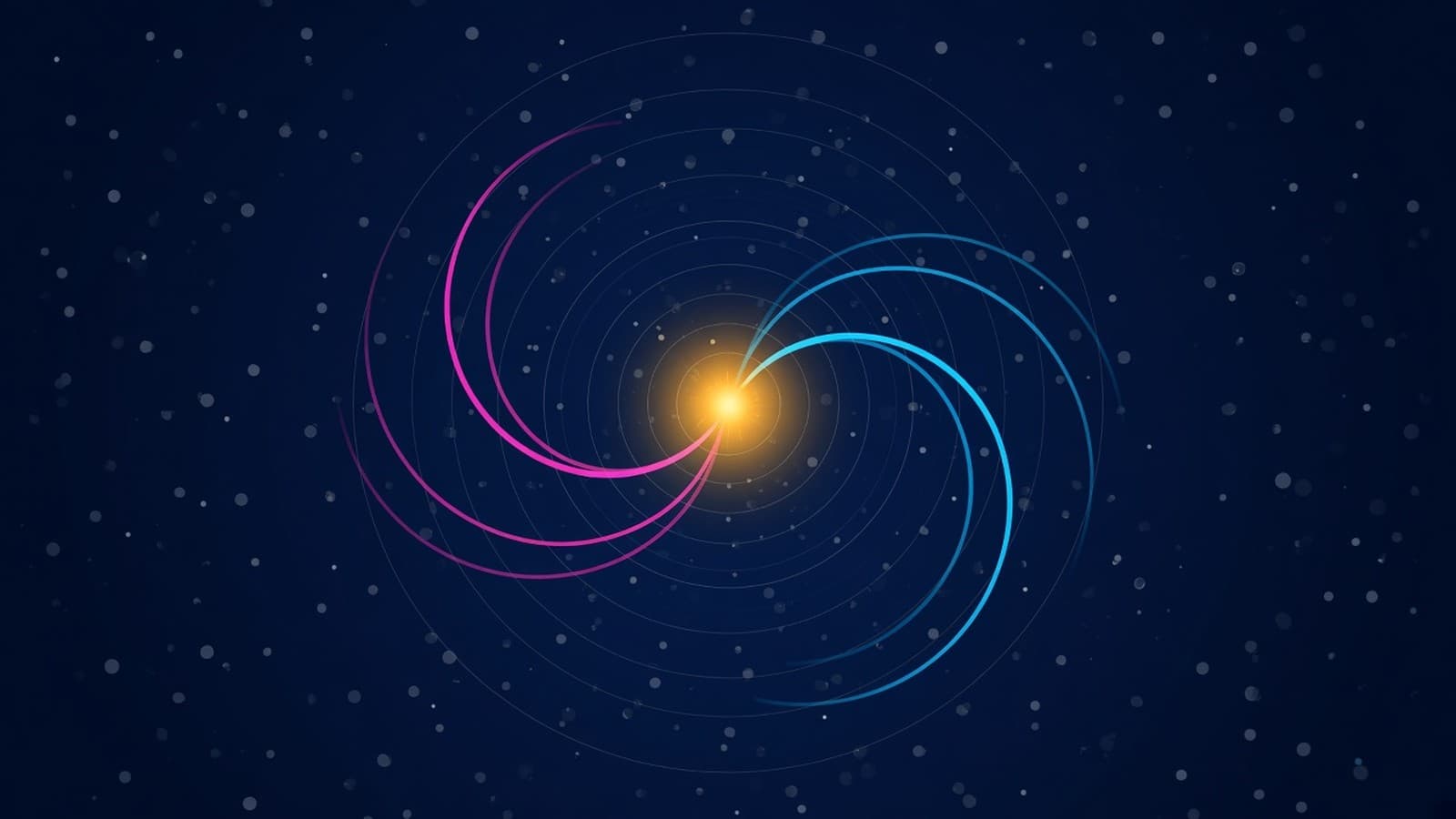
Illustration: FeelArtsy Studio (AI-assisted)
Some discoveries come with a bang. This one came as a whisper you need almost unimaginable patience to hear. In a seminar at CERN on 3 November, the LHCb Collaboration announced evidence for a particle decay that happens roughly once in every ten billion decays of its kind.
What they saw
The particle is called the Bd meson. It is made of a beauty quark bound to a down antiquark. Very rarely, the two annihilate and the energy reappears as a pair of muons, which are heavier cousins of the electron. Physicists write this as Bd → μ⁺μ⁻.
Its sibling decay, involving the Bs meson, was first observed in 2015 and occurs about three times per billion. The Bd version is predicted to be about thirty times rarer still. An earlier joint analysis claimed first evidence for it, but later data did not hold that up. So this is a long-awaited return.
LHCb's new analysis uses data from 2024 and 2025 and reaches a significance of 3.0 standard deviations. Combined with data from 2011–2018, the significance rises to 3.2. In physics, three standard deviations is the bar for "evidence". Five is the bar for a formal "observation", so the team's next goal is clear.
How they pulled it off
Two things made the difference. First, a major upgrade in 2024 let LHCb collect data five times faster than in its first runs and improved its ability to tell particle types apart. Second, machine-learning techniques helped the team strip away an enormous background of ordinary events that would otherwise drown the signal.
"Physicists have been chasing this decay for more than forty years," said Marco Santimaria, who co-led the 19-person analysis team. His co-lead, Harry Cliff, said the result opens new ways to probe physics beyond what the LHC can produce directly.
Why a rare decay matters
The logic is elegant. Quantum theory says heavy, as-yet-unknown particles can subtly influence how ordinary particles decay, even if they are too heavy to create in a collider. The rarer the decay, the more sensitive it is to those hidden influences. For now, the measured rate agrees with the Standard Model, which itself tightens the limits on what new physics could look like.
A note of caution: the result was presented at a seminar and has not yet been through peer review.
Beauty in the data
There's a reason physicists call these "golden channels". There is real visual poetry in a single bright event against a sea of noise. If that idea appeals, look for minimalist dot and gradient work, where one point of colour holds a whole field together.
Palette
- #0A1A3F
- #F5A623
- #E040A0
- #29B6F6
- #E8EAF6
Sources
- LHCb finds evidence of one-in-ten-billion particle decay · CERN
- Physicists knock at the door of the zeptoverse · University of Cambridge
Written by FeelArtsy in our own words. AI may assist the draft. A person reviews it before it is published. See the editorial policy.
From the shop
Prints related to this story. House lines, designed by FeelArtsy Studio.
Dot Gradient Poster
Meridian Block
€24.00
A FeelArtsy Studio line

Halftone Sphere Poster
Meridian Block
€24.00
A FeelArtsy Studio line
Split Moon Poster
Meridian Block
€24.00
A FeelArtsy Studio line

Get the weekly trend letter
One letter a week on art, design, science, and what we printed from it. We store your address as pending and send a confirmation before the first letter. That confirmation email is not going out yet.