Art · News · 4 Oct 2026
Krasner and Pollock at the Met: two painters, one long conversation
Past Continuous gathers more than 120 works to show the couple not as genius and helpmate but as two artists pushing abstraction in parallel, and sometimes literally through each other's canvases.
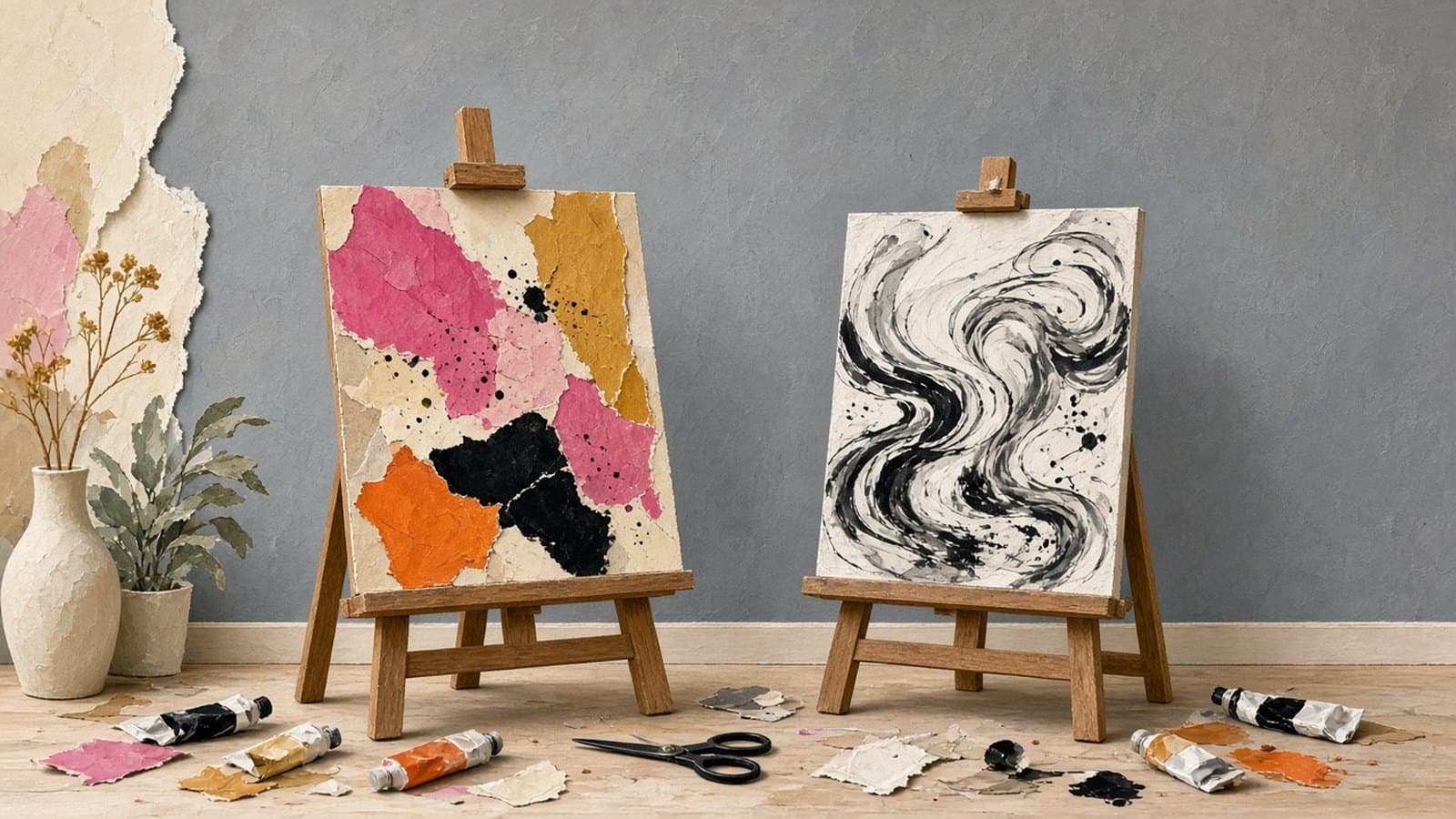
Illustration: FeelArtsy Studio (AI-assisted)
For decades the story went one way: Jackson Pollock was the genius, and Lee Krasner was the wife who supported him. Krasner and Pollock: Past Continuous wants to retire that story. The exhibition opened at the Metropolitan Museum of Art on 4 October and runs until 31 January 2027.
The scale of it
The show brings together more than 120 works. NPR counts 74 by Krasner and 48 by Pollock, a balance that is itself a statement. They come from more than 80 lenders. Christie's notes that this is the first major New York exhibition of either artist in over two decades and the first at the Met. The curators are Brinda Kumar and David Breslin.
Parallel lives
The couple made their home in Springs, a small fishing community at the far end of Long Island. According to curator Brinda Kumar, Krasner chose the place partly to get Pollock away from the business and the drinking of Manhattan. Pollock worked on his enormous canvases in a barn on the property. Krasner painted first in the kitchen, then in a small upstairs bedroom. Asked years later what she was doing while her husband became famous, she gave a famously simple answer: she was working all the time.
The exhibition's title, Past Continuous, captures the point. These were two careers running side by side, informing each other, and they didn't end when the partnership did.
Paintings in dialogue
Some of the most striking moments are about material as much as influence. In Bald Eagle (1955), Krasner cut up works Pollock had discarded and collaged them into her own composition. You can still see his drips in the fragments. The result is a riot of browns, blacks, fuchsia and orange, fierce and entirely her own. Collage, Kumar says, was catalytic for Krasner at key moments. She sometimes tore up her own older work to start a new chapter.
On the Pollock side, Convergence (1952) is hung on a freestanding wall near the windows, with daylight falling across its neon orange and electric yellow. It feels closer to a contemporary gallery than a museum.
Why see it now
The show arrives as museums keep rethinking how they tell the stories of artist couples, and of women in mid-century abstraction in particular. Reviews have been engaged and, in places, argumentative. The Boston Globe weighed in with a long review at the end of October. That's what a good exhibition should provoke.
Taking it home
Abstract Expressionism asks you to read paint as energy: drips, slashes, layers and torn edges. You don't need a masterpiece to live with that idea. Expressive brushwork and bold gestural marks in a limited palette can bring the same pulse to a room. Try black and cream with a single hot accent.
Palette
- #1E1E1E
- #D9C9A3
- #B23A2B
- #2E5E8C
- #E8B33D
Sources
Written by FeelArtsy in our own words. AI may assist the draft. A person reviews it before it is published. See the editorial policy.
From the shop
Prints related to this story. House lines, designed by FeelArtsy Studio.

Brushmark Rhythm Art Print
Still Form
€24.00
A FeelArtsy Studio line

Neon Drip Sticker Sheet
Alley Mark
€10.90
A FeelArtsy Studio line

Heath Storm Canvas
Field Pigment
€59.00
A FeelArtsy Studio line
Get the weekly trend letter
One letter a week on art, design, science, and what we printed from it. We store your address as pending and send a confirmation before the first letter. That confirmation email is not going out yet.