Science · News · 3 Nov 2026
Blood from 115 million years ago: red cells found inside a dinosaur bone
Researchers led by Curtin University report mineralised red blood cells, with chemical traces of heme, inside the limb bones of a theropod dinosaur from Brazil.
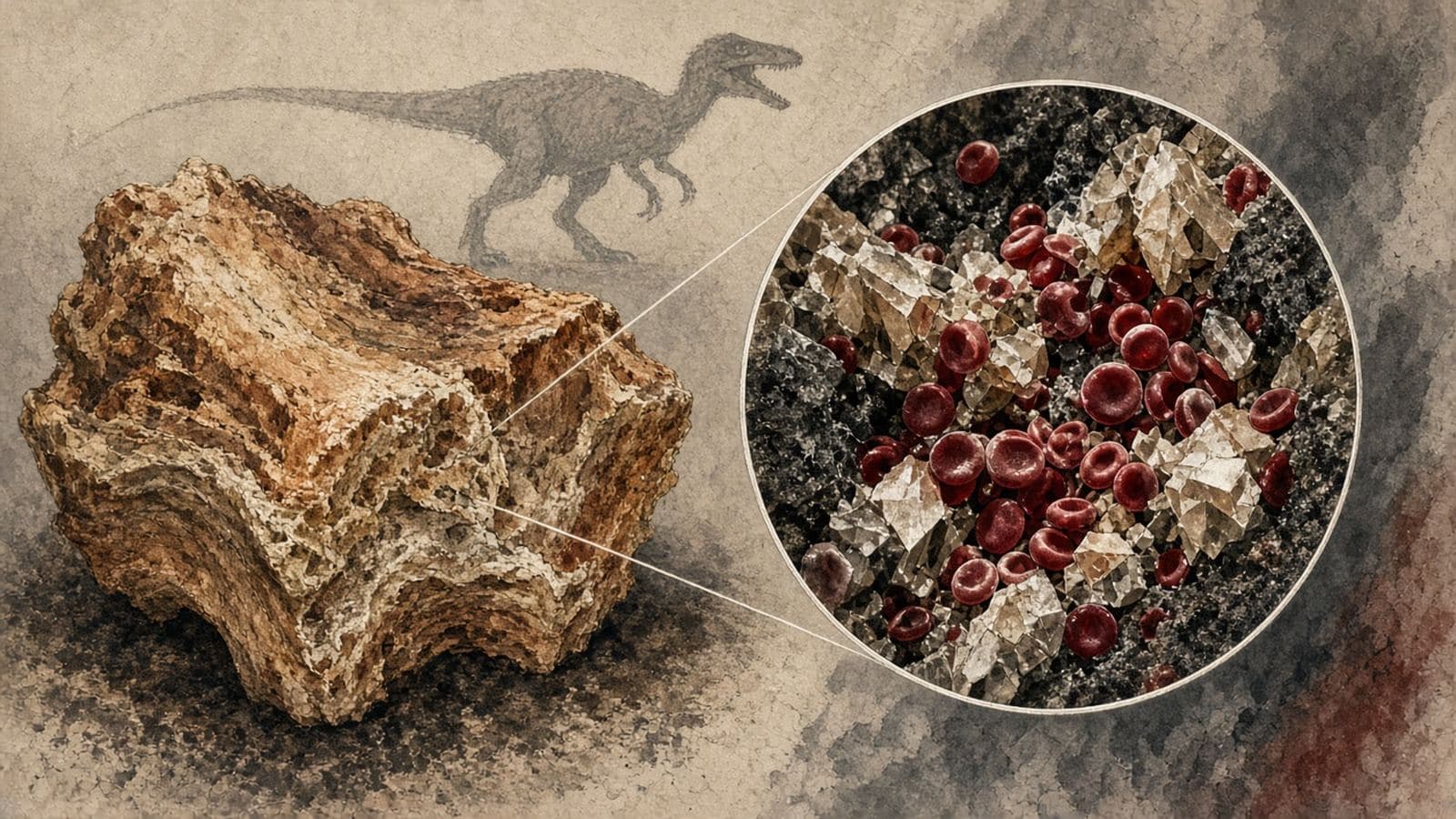
Illustration: FeelArtsy Studio (AI-assisted)
Fossils are usually stone copies of living things. The original material is long gone, replaced by minerals. That's why a paper published in the Proceedings of the National Academy of Sciences and announced on 3 November is so striking. An international team led by Curtin University in Australia reports fossilised red blood cells, with chemical evidence of heme, inside the bones of a dinosaur.
The dinosaur
The bones belong to *Aratasaurus museunacionali, a theropod, part of the group of mostly meat-eating dinosaurs. It lived about 115 million years ago in what is now northeastern Brazil*. The researchers found many red blood cells preserved inside the vascular canals of its limb bones, the channels that once carried blood vessels.
The proof
Earlier studies have reported structures that looked like fossil blood cells. What's new, the team says, is chemical proof. They detected intact molecules derived from heme, the part of haemoglobin that carries oxygen, inside the cells themselves. They also found amino acids from collagen.
How did anything survive that long? The cells were mineralised with hausmannite, a manganese oxide mineral that acted like a natural time capsule. The team thinks the animal was buried quickly, in a low-oxygen, microbe-rich environment, soon after it died.
"To detect intact heme derived molecules in 115-million-year-old red blood cells is astonishing," said lead author Kliti Grice. She says the finding opens a direct molecular window into the physiology of extinct animals.
Why it matters
The study challenges a long-held assumption that molecules like haemoglobin can't survive deep time. If it holds up, it could let scientists study the evolution of blood, metabolism and even activity levels in ancient animals. Curtin's head of school Martin Van Kranendonk notes that it could also inform astrobiology: knowing how biological molecules survive helps us know what to look for elsewhere.
The collaboration included researchers from Japan's JAMSTEC, Brazil's National Museum and Regional University of Cariri, and Johns Hopkins University. Like all big claims, it will be tested by other teams. That's how science works.
Earth tones with a story
This is a story told in reds and sandstones: crimson cells, pale bone, dark mineral. Those earthy colours have a long life in interiors too. Terracotta, ochre and rust feel warm and grounded, and now they come with a 115-million-year-old backstory.
Palette
- #9B1D20
- #D8B98A
- #3D3D3D
- #F2EAD8
- #6B4226
Sources
Written by FeelArtsy in our own words. AI may assist the draft. A person reviews it before it is published. See the editorial policy.
From the shop
Prints related to this story. House lines, designed by FeelArtsy Studio.
Terracotta Forms Art Print
Field Pigment
€22.00
A FeelArtsy Studio line
Ochre Fields Canvas
Field Pigment
€59.00
A FeelArtsy Studio line
Rust and Blue Field Canvas
Field Pigment
€59.00
A FeelArtsy Studio line

Get the weekly trend letter
One letter a week on art, design, science, and what we printed from it. We store your address as pending and send a confirmation before the first letter. That confirmation email is not going out yet.